Showing posts with label Tammi Benjamin. Show all posts

Wednesday, March 23, 2016

LARGEST U.S. PUBLIC UNIV. UNANIMOUSLY PASSES LANDMARK POLICY TO PROTECT JEWISH STUDENTS FROM RISING ANTI-SEMITISM

Press release from the AMCHA Initiative,  a non-profit organization dedicated to combating, monitoring and documenting anti-Semitism at institutions of higher education in America.

San Francisco, CA, March 23, 2016 – To address a rash of anti-Semitic incidents, largely incited by anti-Zionist activity on campus, the University of California today passed a resolution condemning “anti-Semitism, anti-Semitic forms of anti-Zionism and other forms of discrimination” and stating they “have no place at the University of California.”

“What an important day for Jewish students in California, nationally and internationally,” said AMCHA Initiative director Tammi Rossman Benjamin, who began this fight a year ago and led the effort.  “There is absolutely no doubt that anti-Zionism is the driving force behind the alarming rise in anti-Semitism at UC and at schools across the country.  Far too often, anti-Israel activists single out, harass, intimidate and even assault Jewish students, regardless of how that student feels about Israel.  Far too often, what starts as acceptable, welcomed and appropriate criticism and debate on Israel becomes anti-Zionist discrimination and hate.  We applaud the Regents for their leadership and courage today.  We offer a special thank you to Regents Working Group chair Eddie Island, members Norm Pattiz and Avi Oved and California legislators Marty Block and Travis Allen who championed this important policy.  This is a significant step forward for the well-being of Jewish students at UC, and its impact will be felt nationwide.”

AMCHA began communicating with UC Regents and community members a year ago after hearing from concerned parents and students about the rapid rise of anti-Semitism at UC.  In September the Regents appointed a task force to address the problem.  The task force held numerous public meetings and hearings to hear from the community and experts.  Last week they released the proposed Statement of Principles Against Intolerance that was approved unanimously today.
Dozens of UC students and faculty, representatives from Jewish organizations, including, the Anti-Defamation League, Simon Wiesenthal Center, Jewish Community Relations Council, and AMCHA Initiative, and State Assembly Member Travis Allen testified before the Regents today urging them to support the measure. In addition, over the last week, more than 4,000 UC students, faculty, parents, alumni and stakeholders; 60 Jewish and education advocacy groups, including Hillel International, Jewish Federations of North America, and the American Jewish Committee; as well as the California Legislature’s Jewish Caucus and U.S. Congressman Brad Sherman urged the Regents to condemn anti-Semitism and anti-Zionism in the Statement.

Criticism of Israel, Israeli policies, settlements, the living conditions of Palestinians or criticism similar to that leveled against any other country is not anti-Zionism.  Anti-Zionism is denying Israel’s right to exist and/or calling for its destruction.

Far too often, what starts as acceptable, welcomed and appropriate criticism and debate on Israel at UC becomes anti- Zionist discrimination and often includes classic, centuries-old anti-Semitic tropes:
·       Jewish UC Santa Cruz student government rep warned to “abstain” from voting on Israel divestment resolution because of his “Jewish agenda.”
·       At UC Santa Barbara, stereotypical and classic anti-Semitic statements about Jews, including Jews control the government and all Jews are rich, were made during a debate to divest from Israel. 

·       A UCLA student wrote, “Fucking Jews. GTFOH with all your Zionist bullshit. Crazy ass fucking troglodyte albino monsters of cultural destruction. Fucking Jews. GTFOH with your whiny bullshit. Give the Palestinians back their land, go back to Poland or whatever freezer-state you’re from, and realize that faith does not constitute race.”
·       The online promotion of an anti-Israel UC Berkeley SJP event stated, “No to University Coordination and Strategizing with the ADL, JCRC, AJC, StandWithUS, ZOA...” The targeting of Jewish organizations, the Anti-Defamation League, the Jewish Community Relations Council and the American Jewish Committee, demonstrates how anti-Israel student groups target and alienate all Jewish groups. 

·       At UC Berkeley, “Zionists should be sent to the gas chamber” was scrawled on a bathroom wall in the wake of a student senate campaign to pressure the university to divest from American companies that do business with Israel.
·       At UCLA, “Hitler did nothing wrong” was carved into school property after a contentious BDS campaign.
·       At UC Davis, “grout out the Jews” was scrawled on the university’s Hillel House following a heated BDS debate. 

·       At UC Santa Barbara, flyers blaming Israelis and all Jews for 9/11 were posted on campus. 


A study, conducted by AMCHA Initiative, of anti-Semitism at more than 100 U.S. colleges and universities in 2015 ranked 5 UC campuses in the top 10% of schools with the most anti-Semitic activity. In fact, 4 of those UC campuses rose to the top 5 worst schools.  The study also found the presence of anti-Zionist activities, anti-Zionist student groups and faculty who endorse an academic boycott of Israel were strong predictors of anti-Semitism.  
For months UC Jewish students have reported feeling afraid to tell fellow students they are Jewish, walk to the Hillel house for Sabbath dinner and wear a Jewish star necklace. Many report being bullied, harassed, intimidated and assaulted.


Tuesday, May 12, 2015

Tammi Rossman-Benjamin: University of California must fight back against anti-Semitic acts

Tammi Rossman-Benjamin, a faculty member at the University of California, Santa Cruz is the founder of AMCHA Initiative, a non-profit organization that combats anti-Semitism on college campuses. Nominated as a Jewish Community hero, Ms. Rossman has a well earned reputation are a fierce and tireless protector of civil rights of Jewish students, on California campuses and throughout the country

Documenting anti-Semitic incidents in the UC System, she writes in the San Jose Mercury News:

It's not hard to connect the dots. On campuses where anti-Israel Boycott, Divestment, Sanctions (BDS) campaigns have been promoted, anti-Semitism has increased and Jewish students report feeling emotionally and physically harassed, threatened, unsafe, and targeted for anti-Jewish bigotry.

The University of California is no exception. Just in the past few months:

At UC Berkeley, in the wake of a contentious BDS campaign, the message "Zionists should be sent to the gas chamber" was found scrawled on a bathroom wall. This past month, a Jewish student leader reported, "We still find anti-Semitic slogans written on bathrooms. A lot of students find swastikas and come to me," and he added that many Jewish students are frightened.

At UC Davis, in the days leading up to an anti-Israel divestment vote, the university's Hillel House was defaced with "grout out the Jews." Less than two days following the vote, large swastikas were spray-painted on a UC Davis Jewish fraternity. Several Jewish students reported feeling unsafe, one writing: "I no longer feel as though UC Davis is a completely safe environment for Jewish students or a place where I can feel free to express my support for Israel."

At UCLA, shortly after the student government approved an anti-Israel divestment resolution, four student senators who sponsored that resolution brazenly argued that a candidate for the student judicial board was not eligible simply because she was a Jew. According to one Jewish student leader, "People say that being anti-Israel is not the same as being anti-Semitic. The problem is the anti-Israel culture in which we are singling out only the Jewish state creates an environment where it is OK to single out Jewish students."

At UC Santa Barbara, after three years of divisive anti-Israel divestment campaigns, large flyers blaming Jews for 9/11 were posted on campus. At a student senate meeting this past month, a Jewish student shared: "For the first time in my life, I felt that my identity, an unchangeable part of who I am, was under attack and my entire existence as a Jew was being questioned. No one in this room can look at this past year's incidents and tell me that anti-Semitism doesn't exist. ... I'm scared for my safety."

In response to this alarming increase in anti-Semitism, student leaders at UC Berkeley, UCLA and UC Santa Barbara have approved resolutions condemning anti-Semitism.  It’s a start, but its not enough.

Read Tammi Benjamin-Rossmans' recommendations here


Tuesday, November 4, 2014

New Book: The Case Against Academic Boycotts of Israel

Via our friend J.J. Surbeck at SanDiego TEAM News, and the AMCHA Initiative


AMCHA Initiative recommends a new book, “The Case Against Academic Boycotts of Israel,” released this week, which includes essays from more than 25 international scholars who take a hard look at the impact of the academic Boycott, Divestment and Sanctions (BDS) movement.  It tackles tough issues that many have found impossible to confront until now, including the role of antisemitism in calls for the abolition of the Jewish state.  According to Amazon, “This book for the first time provides the historical background necessary for informed evaluation of one of the most controversial issues of our day…”
 
AMCHA Initiative cofounder Tammi Rossman-Benjamin’s chapter, “Interrogating the Academic Boycotters of Israel on American Campuses,” takes a critical look at the individual faculty who support and promote the academic boycott, what ideologies motivate the boycotters, how they have used their university positions to promote the boycott and stifle criticism and which university conditions allow for, and often encourage, this behavior. 


A review of the new book in Fathom Journal had this to say about Rossman-Benjamin's chapter:
  • To my knowledge at least, Tammi Rossman-Benjamin offers the first concrete numerical evidence for a phenomenon that I have observed for years, wondered about repeatedly, but have never quite seen so starkly exposed: that the vast percentage of the faculty boycotters on American campuses – 86 per cent! – belong to the humanities (49 per cent) and the social sciences (37 per cent), with only 7 per cent per cent affiliated with departments in engineering and the natural sciences. Of the 938 boycotters whom Rossman-Benjamin’s meticulous research has unearthed, 192 (21 per cent) are in English or literature departments; 96 (10 per cent) in ethnic studies; 68 (7 per cent) in history; 65 (7 per cent) in gender studies; 53 (6 per cent) in anthropology; 44 (5 per cent) in sociology; 39 (4 per cent) in linguistics and languages; 33 (3 per cent) in American studies; and 32 (3 per cent) in Middle or Near East studies. Why would a professor in an English department at an American university be so much more likely to support BDS than their counterpart in – say – sociology, or even Middle East studies, never mind their colleague in economics, the natural sciences or any of the professional schools be they business, law or medicine? In search for an answer to this question, Rossman-Benjamin examined…
Rossman-Benjamin’s research further found seven primary ways that faculty promote the boycott of Israel on campus: 1) incorporating pro-boycott material into course curricula; 2) hosting academic conferences about boycotting Israel; 3) advocating for the boycott on official university websites; 4) using departmental resources to sponsor student BDS events; 5) advising pro-Palestinian students to engage in boycott activity; 6) infiltrating the academic senate to promote the boycott among academic colleagues and to ensure that boycotting faculty are protected from criticism; and 7) creating faculty advocacy groups under the guise of defending academic freedom but whose true mission is to promote the boycott.  Rossman-Benjamin also cited three university conditions that open the door to this behavior and called for public pressure from students, parents, alumni and donors as the most effective method to prevent professors from abusing their access to vulnerable students and university resources to promote personal propaganda. 
 
 You can buy The Case Against Academic Boycotts of Israel  or download the Kindle here

Wednesday, September 3, 2014

Academics against Academic Freedom


Below is a list of faculty at U.S. universities who have  signed the call by "Middle East Studies Scholars and Librarians for the Academic Boycott of Israel". Call them the  "Academics Against Academic freedom"

Via the Amcha Initiative

From Tammi Rossman-Benjamin, the AMCHA Initiative's co-founder and a faculty member at the University of California, Santa Cruz:

“How can professors who are so biased against the Jewish state accurately or fairly teach students about Israel or the Arab-Israel conflict?” “Students who wish to become better educated without subjecting themselves to anti-Israel bias, or possibly even antisemitic rhetoric, may want to check which faculty members from their university are signatories before registering.”

(Updated 9/2/14)
Universities marked with an asterisk (*) receive federal funding to support programs in Middle East or Near East studies.
Bard College
Dina A. Ramadan, Assistant Professor of Arabic
Boston University
Irene L. Gendzier, Professor Emeritus, Political Science
Brown University
Bashir Abu-Manneh, Visiting Assistant Professor of Comparative Literature
Ariella Azoulay, Professor, Comparative Literature
Beshara Doumani, Joukowsky Family Professor of Modern Middle East History
Bryn Mawr College
Peter Magee, Professor, Department of Classical and Near Eastern Archaeology
California Institute of Integral Studies
Sahar Driver, Anthropology and Social Change
California State University Sacramento
Ayad Al-Qazzaz, Professor of Sociology
California State University San Bernadino
Jamal Nassar, Dean, College of Social and Behavioral Sciences
Central Michigan University
John Robertson, Professor of History
Clark University
Anita Fabos, Associate Professor, Department of International Development, Community, and Environment
College of New Jersey
Miriam Lowi, Professor, Departmet of Political Science
* Columbia University
Nadia Abu El-Haj, Professor of Anthropology
Lila Abu-Lughod, Joseph L. Buttenwieser Professor of Social Science
Gil Andijar, Professor, Departments of Religion and Middle Eastern, South Asian, and African Studies (MESAAS)
Hamid Dabashi, Hagop Kevorkian Professor of Iranian Studies and Comparative Literature
Wael B. Hallaq, Avalon Foundation Professor in the Humanities
Rhoda Kanaaneh, Adjunct Associate Professor, Middle East Institute
Rashid Khalidi, Edward Said Professor of Modern Arab Studies and Professor of History
Mahmood Mamdani, Professor, Department of Middle East, South Asian and African Studies
Brinkley Messick, Professor of Anthropology
Timothy Mitchell, Professor, Department of Middle Eastern, South Asian, and African Studies
George Saliba, Professor of Arabic and Islamic Science Department of Middle East and Asian Languages and Cultures
College of the Holy Cross
Sahar Bazzaz, Associate Professor, Department of History
College of William and Mary
Mumtaz Ahmad, Professor of Political Science, Distinguished Visiting Scholar
Stephen Sheehi, Sultan Qaboos bin Said Chair of Middle East Studies
Colorado School of Mines
Hussein Amery, Associate Professor, Division of Liberal Arts and Intl. Studies
CUNY Graduate Center
Anthony Alessandrini, Associate Professor
Talal Asad, Distinguished Professor of Anthropology
Marilyn Hacker, Professor
Samira Haj, Professor of History
Christa Salamandra, Associate Professor of Anthropology
Dartmouth College
Lara Harb, Assistant Professor
Christopher MacEvitt, Associate Professor of Religion
Denison College
Isis Nusair, Associate Professor of International Studies and Women’s Studies
* Duke University
Miriam Cooke, Braxton Craven Professor of Arab Cultures
Frances S. Hasso, Associate Professor in Women’s Studies and Sociology
Engseng Ho, Professor, Department of Anthropology
Abdeslam Maghraoui, Associate Professor of Practice, Political Science
Evergreen State College
Sarah Eltantawi, Assistant Professor
Farleigh Dickenson University
Riad Nasser, Professor
Florida International University
Cheryl Rubenberg, Retired Professor, Political Science
Fordham University
Aseel Sawalha, Associate Professor, Anthropology
Frostburg State University
Haiyun Ma, Assistant Professor, Department of History
George Mason University
Bassam Haddad, Associate Professor, Department of Public and International Affairs
* Georgetown University
Osama Abi-Mershed, Associate Professor, Department of History, Director, Center for Contemporary Arab Studies
Fida Adely, Associate Professor, School of Foreign Service
Halim Barakat, Retired Professor
Jonathan Brown, Associate Professor, School of Foreign Service
Elliott Colla, Associate Professor, Department of Arabic and Islamic Studies
Rochelle Davis, Associate Professor of Anthropology
Susan Douglass, Education Outreach Director, Center for Contemporary Arab Studies
John L. Esposito, University Professor & Founding Director, Prince Alwaleed Bin Talal Center for Muslim-Christian Understanding
Yvonne Haddad, Professor of History of Islam and Christian-Muslim Relations
Michael C. Hudson, Professor Emeritus, Walsh School of Foreign Service
Laurie King, Visiting Assistant Professor of Anthropology
Lama Abu Odeh, Law Professor
Judith E. Tucker, Professor of History
* George Washington University
Mona Atia, Associate Professor of Geography and International Affairs
Ilana Feldman, Associate Professor, Anthropology, History, and International Affairs
Dina Rizk Khoury, Professor of History
Shira Robinson, Associate Professor of Middle Eastern History
Georgia Tech
Laura Bier, Associate Professor of History
Gettysburg College
Karen Pinto, Assistant Professor
Janet M. Powers, Professor Emerita
Hampshire College
Omar Dahi, Associate Professor of Economics
* Harvard University
Ousmane Kane, Professor of Contemporary Islamic Religion and Society, Harvard Divinity School
Roger Owen, A.J. Meyer Emeritus Professor of Middle East History
Hunter College (CUNY)
Alexander Elinson, Associate Professor of Arabic Language and Literature, Department of Classical and Oriental Studies
Christopher Stone, Associate Professor
Illinois State University
Issam Nassar, Professor of Middle East History
Indiana State University
Glenn Perry, Professor Emeritus of Political Science
Indiana University of Pennsylvania
Christine Baker, Assistant Professor
James Madison University
Manal A. Jamal , Associate Professor of Political Science
John Hopkins University
Todd Shepard, Associate Professor, History
Long Island University
Harriet Malinowitz, Professor of English
Loyola Marymount University
Najwa al-Qattan, Associate Professor
Marquette University
Louise Cainkar, Associate Professor of Sociology
Massachusetts Institute of Technology
Sharon C. Smith, Program Head, Agha Khan Documentation Center
Michigan State University
Salah Hassan, Associate Professor
Montana State University Bozeman
Joan Hoff, Research History Professor
Montclair State University
Fawzia Afzal-Khan, Professor and Director, Women and Gender Studies
Morgan State University
Mary Ann Fay, Associate Professor of History
New School for Social Research
Ann Laura Stoler, Willy Brandt Distinguished Professor of Anthropology and Historical Studies
* New York University
Bassam Abed, Clinical Professor of Social Science, McGhee Division
Sinan Antoon, Associate Professor
Tamer El-Leithy, Assistant Professor of History, Middle Eastern & Islamic Studies
Finbarr Barry Flood, Professor of Art History
Michael Gilsenan, David B. Kriser Professor in the Humanities
Arang Keshavarzian, Associate Professor of Middle Eastern and Islamic Studies
Josefina Saldaña, Professor, Department of Social and Cultural Analysis
Ella Shohat, Professor of Middle Eastern and Islamic Studies; Professor, Art and Public Policy, Tisch School of the Arts
Helga Tawil-Souri, Associate Professor
North Carolina State University
Anne Clement, Assistant Professor of History & International Studies
Northeastern University
Ilham Khuri-Makdisi, Associate Professor of History
Northern Arizona University
Yaseen Noorani, Associate Professor, School of Middle East and North African Studies
Scott Reese, Professor of History
Northern Illinois University
Tomis Kapitan, Professor (Emeritus), Philosophy Department
Northwestern University
Katherine Hoffman, Associate Professor of Anthropology
Uri Horesh, Assistant Professor of Instruction, Middle East and North African Studies
Jessica Winegar, Associate Professor, Anthropology
Ohio University
Louis-Georges Schwartz, Associate Professor
Pennsylvania State University – Altoona College
Beth Seymour, Instructor of Anthropology, Communications, History and Women’s Studies
* Princeton University
Richard Falk, Milbank Professor of International Law Emeritus
Molly Greene, Professor
Max Weiss, Associate Professor of History and Near Eastern Studies
Queens College – CUNY
Ammiel Alcalay, Professor, Classical, Middle Eastern & Asian Languages & Cultures
Ron Hayduk, Professor, Political Science
Rutgers University – New Brunswick
Toby Jones, Associate Professor
Yasmine Khayyat, Assistant Professor, African, Middle Eastern, and South Asian Languages and Literatures
Elektra Kostopoulou, Lecturer
Jasbir Puar, Associate Professor
Samah Selim, Associate Professor, Department of African, Middle Eastern and South Asian Languages and Literatures
Sacramento City College
Riad Bahhur, Professor, Department of History
St. Lawrence University
John Collins, Professor of Global Studies
St. Mary’s College of Maryland
Betul Basaran, Associate Professor of Religious Studies
St. Olaf College
Linda Mokdad, Assistant Professor
San Francisco State University
Rabab Ibrahim Abdulhadi, Associate Professor of Ethnic Studies/Race and Resistance Studies
Dina Ibrahim, Associate Professor, Media and Communication
Scripps College
Lara Deeb, Professor of Anthropology
Simmons College
Elaine Hagopian, Professor Emerita of Sociology
Southern Illinois University Edwardsville
Steve Tamari, Associate Professor
Stanford University
Joel Beinin, Donald J. McLachlan Professor of History and Professor of Middle East History
SUNY-Plattsburgh
Simona Sharoni, Professor
Swarthmore College
Farha Ghannam, Associate Professor, Anthropology
Syracuse University
Carol Fadda-Conrey, Associate Professor, Syracuse University
Amy Kallander, Associate Professor of Middle East History
Texas State University
Elizabeth Bishop, Associate Professor
Trinity College
Zayde Antrim, Associate Professor of History and International Studies
Vijay Prashad, Professor of International Studies
Tufts University
Kamran Rastegar, German, Russian and Asian Languages and Literatures
University of Arizona
Linda T. Darling, Professor of History
* University of California, Berkeley
Hatem Bazian, Lecturer, Near Eastern Studies and Ethnic Studies
Samera Esmeir, Associate Professor, Department of Rhetoric
Gretchen Head, Visiting Assistant Professor
Charles Hirschkind, Associate Professor, Anthropology
Saba Mahmood, Associate Professor, Department of Anthropology
Laurence Michalak, Emeritus Vice Chair, Center for Middle Eastern Studies
Smadar Lavie, Scholar in Residence, Beatrice Bain Research Group
Minoo Moallem, Professor of Gender & Women’s Studies
Stefania Pandolfo, Professor, Department of Anthropology
University of California, Davis
Omnia El Shakry, Associate Professor, Department of History
Sunaina Maira, Professor
Suad Joseph, Distinguished Professor of Anthropology and Women’s Studies
Noha Radwan, Associate Professor of Arabic and Comparative Literature
University of California, Hastings College of the Law
George Bisharat, Professor
University of California, Irvine
Mark LeVine, Professor of Modern Middle Eastern History
* University of California, Los Angeles
Khaled Abou El Fadl, Distinguished Professor of Islamic Law
Nouri Gana, Professor
Sondra Hale, Research Professor/Professor Emerita, Departments of Anthropology and Gender Studies
Gabriel Piterberg, Professor of Middle East History
Aamir Mufti, Associate Professor
Susan Slyomovics, Professor Anthropology
University of California, Riverside
Sherine Hafez, Associate Professor, Women’s Studies and Middle East & Islamic Studies
Jeffrey Sacks, Associate Professor
University of California, San Diego
Michael Provence, Associate Professor of History
University of California, San Francisco
Claudia Chaufan, Associate Professor, Health Policy and Sociology
University of California, Santa Barbara
Nancy Gallagher, Research Professor, Department of History
Adam Sabra, Professor of History and King Abdul Aziz Ibn Saud Chair in Islamic Studies
Sherene Seikaly, Assistant Professor, History
University of California, Santa Cruz
Jennifer Derr, Assistant Professor, Department of History
Camilo Gomez-Rivas, Assistant Professor
* University of Chicago
Fred M. Donner, Professor of Near Eastern History, Department of Near Eastern Languages & Civilizations
Lisa Wedeen, Mary R. Morton Professor of Political Science and the College
University of Colorado, Boulder
John Willis, Associate Professor
University of Connecticut
James C. Faris, Professor Emeritus, Anthropology; Director Emeritus, Program in Middle East Languages and Area Studies
University of Dayton
Ellen Fleischmann, Professor, Department of History
University of Delaware
Muqtedar Khan, Associate Professor
University of Hartford
Robert Lang, Professor of Cinema
University of Hawai’i at Manoa
Ibrahim Aoude, Professor
Farideh Farhi, Lecturer and Affiliate Graduate Faculty of Political Science
University of Illinois at Chicago
Nadine Naber, Associate Professor
University of Illinois at Urbana-Champagne
Asef Bayat, Catherine and Bruce Bastian Professor of Global and Transnational Studies and Professor of Sociology and Middle Eastern Studies
Wail S. Hassan, Professor of Comparative Literature and English
Linda Herrera, Associate Professor
Susan Koshy, Associate Professor
Faranak Miraftab, Professor, Department of Urban and Regional Planning
University of Iowa
Yasmine Ramadan, Assistant Professor of Arabic
University of Louisville
Julie Peteet, Professor of Anthropology
University of Maryland
Charles Butterworth, Emeritus Professor
University of Mary Washington
Farhang Rouhani, Associate Professor
Ranjit Singh, Associate Professor
University of Massachusetts – Amherst
Laura Doyle, Professor of English
University of Massachusetts – Boston
Leila Farsakh, Associate Professor of Political Science
University of Miami
Christina Civantos, Associate Professor
* University of Michigan, Ann Arbor
Evelyn Alsultany, Associate Professor, American Culture
Kathryn Babayan, Associate Professor of History, Director of the Center of Armenian Studies
Rima Hassouneh, Lecturer II, Near Eastern Studies
Khaled Mattawa, Associate Professor, Department of English
Anton Shammas, Professor of Middle Eastern Studies and Comparative Literature
Ronald Grigor Suny, Charles Tilly Collegiate Professor of Social and Political History
* University of North Carolina, Chapel Hill
Cemil Aydin, Associate Professor of History
Juliane Hammer, Associate Professor, Religious Studies Department
Sarah Shields, Professor
Nadia Yaqub, Associate Professor and Chair, Department of Asian Studies
University of North Texas
Nada Shabout, Professor of Art History
* University of Pennsylvania
Anne Norton, Professor of Political Science
University of Pittsburgh
Mohammed Bamyeh, Professor of Sociology
University of Richmond
Sheila Carapico, Professor of Political Science and International Studies
University of Southern California
Sarah Gualtieri, Associate Professor of History and American Studies
* University of Texas at Austin
Kamran Asdar Ali, Associate Professor, Anthropology
Barbara Harlow, Louann and Larry Temple Centennial Professor of English Literature
Univesity of the Pacific
Ahmed Kanna, Assistant Professor of Anthropology, School of International Studies
University of Wasington-Bothell
Karam Dana, Assistant Professor
* University of Washington – Seattle
Arzoo Osanloo, Associate Professor, Law, Societies, and Justice
Chandan Reddy, Associate Professor
University of Wisconsin – Madison
Samer Alatout, Associate Professor, Department of Community & Environmental Sociology
Virginia Commonwealth University
Faedah Totah, Associate Professor, Political Science Department
Wake Forest University
Michaelle Browers, Associate Professor of Politics and International Affairs
Charles Wilkins, Associate Professor, History Department
Wayne State University
Barbara Aswad, Professor Emeritus of Anthropology, and Past President of the Middle East Studies Association of North America
May Seikaly, Associate Professor of Modern Middle East History
Wellesley College
Lamia Balafrej, Assistant Professor, Art Department
Lidwien Kapteijns, Professor of History
Sima Shakhsari, Assistant Professor
West Chester University
Lawrence Davidson, Professor of History, Department of History
Whitman College
Elyse Semerdjian, Associate Professor of History
* Yale University
Zareena Grewal, Assistant Professor of American Studies and Religious Studies, Faculty at Council on Middle East Studies
Dimitri Gutas, Professor of Arabic

Tuesday, September 2, 2014

Jewish Organizations Express Concern over Hatem Bazian's proposed day of hate against Israel

Hatem Bazian, the man who notoriously called for an intifada in America has used his facebook page to call for an International Day of Action against Israel on September 23, 2014.

Tammi Benjamin,co-founder of the AMCHA initiative and a fearless advocate for Jewish students on campus has expressed her concerns about Hatem’s proposal in an open letter to UC Berkeley Chancellor Dirks, writing on behalf of Alpha Epsilon Pi Fraternity (AEPi) ,Americans for Peace and Tolerance, Brandeis Center for Human Rights Under Law ,Committee for Accuracy in Middle East Reporting in America (CAMERA) ,Endowment for Middle East Truth (EMET) ,Hasbara Fellowships ,Institute for Black Solidarity with Israel ,National Conference on Jewish Affairs Proclaiming Justice to the Nations ,Scholars for Peace in the Middle East ,Simon Wiesenthal Center, StandWithUs, The Lawfare Project , and the Zionist Organization of America.

From her open letter
... In the wake of the Israel-Gaza conflict, global antisemitism has reached levels not seen since the Holocaust. Jews throughout the world are being targeted for threats, physical assaults and murder, and Jewish property for desecration and destruction. While we fully support academic freedom and students' freedom of expression, these types of demonstrations can result in antisemitic rhetoric and violent behavior, creating a hostile and unsafe environment for Jewish students. Just days ago, a Jewish student at Temple University was punched in the face and called "baby-killer, racist, Zionist pig" and "kike" as he stood next to a table run by the Students for Justice in Palestine (SJP).

As you may be aware, the UC Berkeley SJP group, which was in fact founded by Dr. Bazian himself when he was a graduate student in 2001, has a long history of engaging in antisemitic behaviors targeting Jewish and pro-Israel students for harassment, intimidation, bullying and even assault. Dr. Bazian's call for students to engage in aggressive and potentially illegal actions against Israel and its campus supporters -- actions that include "civil disobedience" -- can only exacerbate the already hostile environment for pro-Israel Jewish students and create the conditions that could well lead to violence on your campus.

Moreover, Professor Bazian is promoting an academic boycott of Israel which calls for shutting down opportunities for students to study in Israel and severing all ties with Israeli universities and scholars -- a boycott which more than 250 university presidents, including yourself, have called a subversion of academic freedom, and which has been decried as antisemitic by government officials and Jewish leaders. Furthermore, we believe that it is highly inappropriate for Dr. Bazian, a faculty member at UC Berkeley, to incite students to engage in "civil disobedience", behavior which is potentially illegal and may lead to adverse consequences for the students and others.

We wanted to bring this to your attention immediately so you could monitor the behavior of SJP and other student organizations involved in the September 23 Day of Action, and ensure, through the use of campus police and administrative oversight, that behavior which violates university policy or the law will be swiftly and appropriately addressed, and that Jewish and pro-Israel students will not be harassed, intimidated, bullied or assaulted.


h/t  Our friend Gary at Fousesquawk

Saturday, August 30, 2014

Steven Salaita: Free Speech for me but not for thee

Former Virginia Tech professor Steven Salaita accepted an offer of a tenure-track position at the University of Illinois at Urbana-Champaign earlier this month, yet his contract was never submitted to the University Board of trustees for approval. According to University of Illinois chancellor Phyllis Wise the application was stonewalled  because the University  "cannot tolerate “personal and disrespectful words or actions that demean and abuse either viewpoints themselves or those who express them.”


“We have a particular duty to our students to ensure that they live in a community of scholarship that challenges their assumptions about the world but that also respects their rights as individuals. A Jewish student, a Palestinian student, or any student of any faith or background must feel confident that personal views can be expressed and that philosophical disagreements with a faculty member can be debated in a civil, thoughtful and mutually respectful manner. Most important, every student must know that every instructor recognizes and values that student as a human being. If we have lost that, we have lost much more than our standing as a world-class institution of higher education,” Wise sent in a mass e-mail to the campus community Friday afternoon.

Steven Salaita is under fire  for a series of postings on social media.


You may be too refined to say it, but I’m not,” Salaita wrote shortly after three Israeli teenagers were kidnapped and murdered by Hamas terrorists, “I wish all the fucking West Bank settlers would go missing.” Another tweet applied just as much nuance in declaring, “Zionists: transforming ‘anti-semitism’ from something horrible into something honorable since 1948.” Subject that last utterance to a close reading—an exercise that passes for rigid and original thinking in most American universities these days—and you learn that the author approaches anti-Semitism with the one-two punch of unreality: It doesn’t exist—hence the quotation marks—and if it does exist then it’s nothing to be ashamed of.

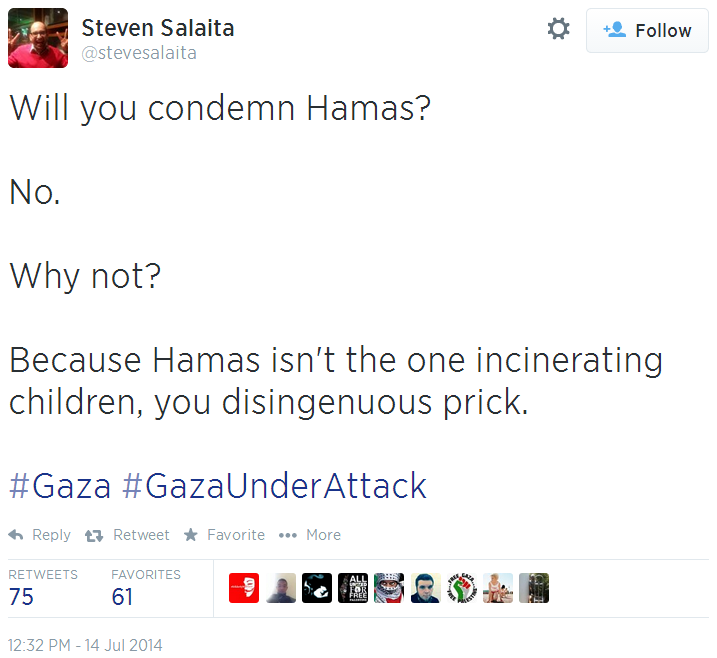
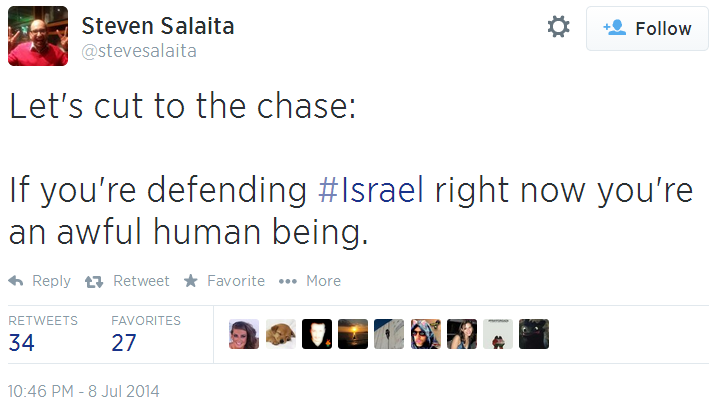
There’s much more where that came from: fantasies about Benjamin Netanyahu wearing a necklace made of Palestinian children’s teeth or about Israel resurfacing Atlantis only to colonize it, categorical refusals to condemn Hamas, and the ever-nuanced statement that anyone supporting Israel during the war in Gaza was “an awful human being.”

Salaita has become the last cause celeb for anti-Israel activists, who have created a petition that erroneously accuses the administrative of "firing" him .

For all the talk of "academic freedom" and "free speech"  bantered about in this made-up controversy,  Salaita's defenders are his ideological compatriots, and the lofty principles they claim to uphold are a smokescreen.   Not a single one of the signators on the petition took a stand to protect the free speech or academic freedom of UC Santa Cruz lecturer Tammi Benjamin , who endured a campaign of character assassination, abuse and ostracism for simply speaking her mind.

If your stand  is "Free Speech for me, but not for thee", then don't evoke the principle of "academic freedom" to justify your actions. 

Tuesday, November 26, 2013

From Elder of Ziyon: SFSU's GUPS president explains that he wants to see all Israelis dead

This story isn't going away any time soon.

More details are emerging regarding the GUPS event at San Francisco State that featured placards inciting violence and glorifying murder. The Electronic Intifada has jumped into the act, attempting to pawn off responsibility for the offensive stencil ("My heroes have always killed Colonizers" ) on the San Francisco State University Student Kouncil of Intertribal Nations, (SKINS).

Swing and a miss.

They are late to the game. They’ve missed some rather striking information regarding the President of GUPS, revealed by blogger Elder of Ziyon.

It seems the President of the General Union of Palestinian Students (GUPS)  at San Francisco State University , Mohammad Hammad  isn't quite the  "peace activist" he pretends to be.  On the Facebook page of his organization, he wrote:
We are appalled at this blatant attack against the integrity and principled position that GUPS has maintained throughout its history. We are horrified by the baseless attack and allegations of anti-Semitism that have been leveled against GUPS and the Cesar Chavez Student Center, the organizers of the 6th annual anniversary of the Palestinian Cultural Mural honoring the late professor Edward Said."
Principled?
Maybe not.
Baseless?
I don't think so.

From our friends at Elder of Ziyon:

SFSU's GUPS president explains that he wants to see all Israelis dead

Apparently,  Hammad has three Tumblr accounts, which have all recently become password protected: palestinianliberator, canttouchthisnuhnuhnuh, and astrangerdanger. Between the time that the disgusting signs were publicized and the time that the GUPS realized that they have a public relations problem, Hammad described to his friends on Tumblr exactly who the target of the signs are - and his opinion does not refer only to to Jews who lived in Israel in the 1940s:

 You know what?

 Israelis ARE colonizers, there is literally no way around it

And you know what else?

My heroes HAVE always killed colonizers

I literally see nothing wrong with this
and my only regret is that not all colonizers were killed 
Here is an essay Hammad wrote last April (again, from his recently taken down Tumblr account) where he explicitly calls for the destruction of Israel, with violence if necessary: 
I will no longer support the two-state solution, and will vie for the liberation of Palestine through the reclamation of the lands that are rightfully ours through any means necessary. If the Israelis want to live in peace with us, so be it, but this peace will NOT be on their terms. It may be Palestinian freedom fighters who pull the triggers, but whatever lives are lost in the battle for liberation rest squarely on the shoulders of Israel.

Until return, and until liberation, one-state for Palestinians through any means necessary.


The president of GUPS has made it crystal clear, in his own words, that he interprets the "MY HEROES HAVE ALWAYS KILLED COLONIZERS" sign as a call to kill Israeli Jews (he is not calling to kill Israeli Arabs!)Let's see GUPS try to spin this. 

I predict they will go on a wild attack, because misdirection is the last refuge for people caught with their pants down.

Elder is likely right on this one.  In spite of widespread condemnation  across the board, the offending students have dug in their heels and refused to apologize. Instead, they are channeling their venom towards Tammi Benjamin, the courageous human right activist that helped expose them. Attacking the messenger- its the cowards way out.

Saturday, November 23, 2013

San Francisco State: Beating a dead horse


"My Heroes have always killed colonizers" at SFSU
"My heroes have always killed colonizers'", the notorious little art project  associated with SFSU's General Union of Palestinian students (GUPS) has been widely condemned in mainstream sources, by advocacy groups as well as in the blogsphere.

ADL  Troubling Glorification Of Violence At Pro-Palestinian Event At San Francisco State University
Camera on campus  SFSU President Condemns Campus Event With Slogan “My Heroes Have Always Killed Colonizers”
The Times of Israel: SF State president slams pro-Palestinian placards
San Francisco Examiner:  Anti-Semitic writing alleged at S.F. State event
JTA: S.F. State president condemns placards at Palestinian event
Algemeiner: SF State University Condemns Anti-Semitic Campus Demonstration After Protest From Jewish Group
AMCHA  AMCHA Co-Founders Challenge San Francisco State University President about Campus Event Glorifying the Murder of Jews
J weekly Outcry over anti-Semitism at mural event at S.F. State

As usual the Blogsphere was at least two steps ahead of the conventional news sources.

Special thanks for recognizing that this incitement to violence and murder on campus deserved  additional exposure goes to:

Gary Fouse  San Francisco State University Keeps its Radical Legacy Alive
More on the San Francisco State University Farce
Radicalism at Work at SFSU  SFSU President Statement on Posters Glorifying Murder
 Elder of Ziyon   SFSU Pal student group signs "My heroes have always killed colonizers"
SFSU "MY HEROES KILL COLONIZERS" followup: President wimps out, haters double down
Israellycool  San Francisco State University Student Openly Supports Terrorists  
Is Limousine Driver The New Baggage Handler?
Simply Jews San Francisco State University: Jew-Hatred Unlimited

Even Mondoweiss, Richard Silverstein, Electronic Intifada and the usual agitprop sites haven't been able to spin this one into a statement of the eternal victimhood of the Palestinians. They are keeping away from it with the proverbial10 foot pole. 

The involved students? Their reaction after being called on threats of violence was to respond with...wait for it....MORE threats of violence.  From the Tumblr account of Mohammed Hammad, president of GUPS,
                                "THIS IS MY THING.  I AM READY TO DESTROY"


In a move straight out of Mad Men ("If you don't like whats being said, change the conversation"), GUPS  is spearheading a petition accusing  Jewish Community hero Tammi Benjamin of attempting to muzzle their "academic freedom" to agitate violence and murder.

Alexandra Thornton of Southport signs the petition with her well-reasoned explanation "Zionists suck a lot"


Angelika Schneider weighs in on SFSU campus climate all the way from Lilienthal Germany. She apparently believes that supporting murder provides moral support for the Palestinians

And from Strasbourg France, Gunter Schneck describes the glorification of murder as "sacred"


Torange Yeghiazarian from Oakland California writes in against "fear mongering and threats", yet bafflingly signs the petition supporting incitement to violence. At least Torange is in the same time zone as San Francisco State


Lets give UC Berkeley Prof.Andrew Gutierrez the last word. He exhorts us to "allow freedom of discussion on campus". 

You may remember Prof. Gutierrez from this outburst,  asserting his own "freedom of discussion" at the top of his lungs.


I can't help but wonder- do any of these people actually know what they have endorsed?

SFSU President Leslie Wong gets it.  The Office of the President at SFSU issued a statement declaring “There is no place at S.F. State for celebrating violence or promoting intolerance, bigotry, anti-Semitism or any other form of hate-mongering...  The university is a place where dialogue, debate and the marketplace of ideas are cherished. We must also maintain a safe environment. Engaging in expressions that threaten and intimidate are counter to these goals"

Tuesday, May 21, 2013

MESA's Peter Sluglett's Orwellian World View

A training seminar for teaching students about the Israel/Palestine issue was recently held at San Jose State University. “Peace Building & Approaches to Teaching the Israeli-Palestinian Conflict,” was an all-day workshop for high school teachers and college and university professors on “how to educate students about the Israeli-Palestinian conflict”. It was all about presenting a balanced perspective, and the composition of the panel ensured this balance- on the panel were anti-Israel Jews as well as anti-Israel non-Jews.

A letter written by the Amcha Initiative to the president of San Jose State expressed concern that the  workshop, organized by SJSU Coordinator for Middle East Studies, Professor Persis Karim, and sponsored by the SJSU Middle East Studies Program (MdES) violated "both the letter and spirit of the federally-funded USIP and Title VI grants, by engaging in anti-Israel advocacy and partisanship rather than truly educating participants about all sides of the complex Israeli-Palestinian conflict"

Nonetheless, the workshop went on as planned.

Recently California Public Records act request was sent, requesting information on the funding of the seminar.   The California Public Records Act (Statutes of 1968, Chapter 1473; currently codified as California Government Code §§ 6250 through 6276.48)  was signed into law in 1968 and requires disclosure of governmental records to the public upon request.  Its all about transparency.  Sunshine, after all, is the best disinfectant. You'd think this would be a universal value amongst academics. You'd think all progressive thinkers would agree with this.

Maybe not.

This fascinating open letter was sent by the President of the  Middle East Studies Association of North America (MESA) and its Committee on Academic Freedom.

In a completely  Orwellian twist, Prof. Sluglett feels that requesting the disclosure of funding sources under the California Public Records Act is harassment and an affront to academic freedom..  His organizational commitment to  "ensuring academic freedom and freedom of expression"  fell to the wayside when Tammi Benjamin was  repeatedly attacked and harassed for expressing her academic freedom and freedom of expression.

Its "free speech for me and not for thee". We've seen this all too frequently. His letter follows:

Dr. Mohammad Qayoumi

President
San José State University
Office of the President
Tower Hall 207, One Washington Square
San Jose, CA 95192
via fax 408-924-1199


Dear President Qayoumi:

We are writing on behalf of the Middle East Studies Association of North America (MESA) and its Committee on Academic Freedom to express concern about the response of San José State University to the ongoing controversy surrounding the April 19, 2013 workshop for high school teachers and community college faculty on teaching the Israeli-Palestinian conflict that was organized by Professor Persis Karim, a member of your university’s faculty.

MESA was founded in 1966 to promote scholarship and teaching on the Middle East and North Africa. The preeminent organization in the field, the Association publishes the International Journal of Middle East Studies and has nearly 3000 members worldwide. MESA is committed to ensuring academic freedom and freedom of expression, both within the region and in connection with the study of the region in North America and elsewhere.

The workshop in question, “Peacebuilding, Nonviolence, and Approaches to Teaching the Israeli-Palestinian Conflict,” was organized by Professor Persis Karim of the Department of English and Comparative Literature with funding from the United States Institute of Peace. The workshop was organized to provide high school and community college educators the opportunity to explore ways of working with students that would help them understand this conflict more fully.

It is our understanding that even before the workshop took place, Professor Karim was subjected to a campaign of harassment and intimidation by individuals and organizations, mostly based outside San José State, who objected to the workshop’s content and participants. This campaign has continued even after the workshop, most recently by means of the circulation of a fabricated statement falsely attributed to Professor Karim and intended to damage her reputation, but also in the form of a request under the California Public Records Act that Professor Karim make available all documents and correspondence related to the workshop and its funding.

We are concerned that these attacks on Professor Karim and on the workshop have created an atmosphere of intimidation that threatens her academic freedom but that may also have a chilling effect on the free exchange of ideas at San José State. We are, moreover, concerned that your administration has thus far failed to defend Professor Karim’s academic freedom rights, and denounce the campaign against her, in a vigorous, unqualified and public manner.

As you are no doubt aware, the principles of academic freedom require that the right of faculty at institutions of higher education to engage in research, teaching, and public presentations be vigorously protected, even when some people may deem their views on issues of public interest to be controversial. We would also point out that no single public event sponsored by San José State or any other university can be expected, or should be required, to represent all possible perspectives on a particular conflict. Rather, universities must encourage and protect the expression of many different viewpoints, in different formats and on different occasions, in order to foster the full and free exchange of ideas and opinions.

We understand that the university must comply with all legitimate requests made under the California Public Records Act, but we are concerned that the information this particular request may yield could be used to harass and intimidate individuals involved in the workshop, whether as organizers or as participants. More broadly, we feel that such requests should not be used to further the political agenda of individuals or groups who do not share the perspectives expressed at a university-sponsored event of this kind.

We urge you to issue a strong and clear public statement expressing the university’s support for academic freedom in general and that of Professor Karim in particular, and its firm condemnation of the smear campaign being waged against her. Professor Karim and all those involved with the workshop, as well as your university’s faculty and students, need to know that San José State is fully committed to defending its faculty against efforts to harass and intimidate them when they share their expertise and their informed perspectives, in the classroom and beyond.


Sincerely,
Peter Sluglett
MESA President
Visiting Research Professor, Middle East Institute, National University of Singapore

Singapore  is ranked in 149th position in terms of press freedom, according to an annual report by NGO Reporters without Borders.   With his selective judgement and moral hypocrisy, Prof. Sluglett must feel right at home.
 

Tuesday, May 14, 2013

Tammi Benjamin Under attack: A troubling Double Standard at the University of California.

From  an article by Thomas Lifson , originally published in the American Thinker:

A troubling double standard appears to exist when it comes harassment at the publicly funded University of California. The University has taken strong action against harassment, physical assault, terrorization and targeting individuals on the basis of their ethnic origin or religion -- except when the person under assault is Jewish, and the perpetrator is a member of an antisemitic or jihadi front group. Then UC administrators have no time to answer emails pleading for protection...
Only one professor in the entire University of California so far has had the intestinal fortitude to speak out about the growing jihadi harassment of Jewish students on campus, a beloved part-time professor of Hebrew at U.C. Santa Cruz, Tammi Benjamin, who has appeared often in AT articles.

After the Civil Rights law was re-interpreted to include Jews in 2010, Tammi Benjamin made history by successfully applying for the federal Office of Civil Rights to investigation the hostile environment for Jews at UC Santa Cruz. If she wins, it will be first time the Civil Rights law is applied to antisemitism. 
     

     Her students love her:
Tammi is AMAZING. I've taken dozens of language classes in my life, and Tammi is hands down one of the greatest teacher's I've ever had. Her lesson plans are great, the course is thorough, and she is dedicated to helping you learn AND get a good grade. You'd have to honestly try to do badly in her classes. Wonderful person, wonderful teacher.
Frustrated by the increasing level of anti-Semitic intolerance on campus, as well as the vitriolic rhetoric directed against her personally Tammi Benjamin wrote a letter to the President of the UC system

As Tammi describes in a letter to the president of UC published this week on the website of her organization, the AMCHA Initiative, she is being harassed mercilessly for having exercised her free speech off campus….

In her letter to President Yudof, Tammi detailed clearly antisemitic actions tolerated on UC campuses, which are illegal by university rules.

At an SJP rally at UCB in 2002, UCB Lecturer Hatem Bazian, then a graduate student and co-founder of the first SJP chapter in America, told a large crowd, "Take a look at the type of names on the buildings around campus -- Haas, Zellerbach -- and decide who controls this university."

Former Nation of Islam member Imam Abdul Malik Ali, a frequent speaker on many UC campuses, has railed against the "disproportionate numbers of Jews, Zionist Jews, in the media, in finance and foreign policy."

At an MSU-sponsored speech at UCI in 2001, Imam Mohammed Al-Asi said: "We have a psychosis in the Jewish community that is unable to co-exist equally and brotherly with other human beings. You can take a Jew out of the ghetto, but you can't take the ghetto out of the Jew".

Al-Asi also actively promotes the lie that Jews were behind the 9-11 attack, stating: "Where were the 4,000 to 5,000 Israeli Jews that were supposed to be in those two buildings on the 11th... Did they know something we didn't know?"

Imam Abdul Alim Musa, a frequent speaker for the MSU at UCI, sells at some of his events copies of an antisemitic book, The Ascendant Qur'an, which blames Jews for conspiring against Islam. Musa maintains contact with virulently antisemitic groups such as Jamaat al-Muslimeen, which promotes Holocaust denial and anti-Jewish conspiracy theories.

Tammi concludes her letter:

As a result of the hostile environment created by these chapters and their members, Jewish students have reported feeling physically unsafe, harassed, and intimidated while on campus, and some have even reported leaving the university, avoiding certain parts of campus, and hiding symbols of their Jewishness.


Students can be pro-Palestinian without resorting to physically confrontational, disruptive, and virulently aggressive behavior and it is this behavior, which continues to escalate, that deeply concerns me. Expressing support for the Palestinians is not the same as chanting "Death to Jews!" "Death to Israel"...O Jews, the army of Mohammed is coming for you," or holding banners that read "Death to Zionism" and "Long Live the Intifada."

The quiescence and timidity of the academic community in the face of these continuing personal attacks on Prof. Benjamin must be challenged. Dr. Martin Luther King Jr famously declared "In the end, we will remember not the words of our enemies, but the silence of our friends." Its time to break the silence.